


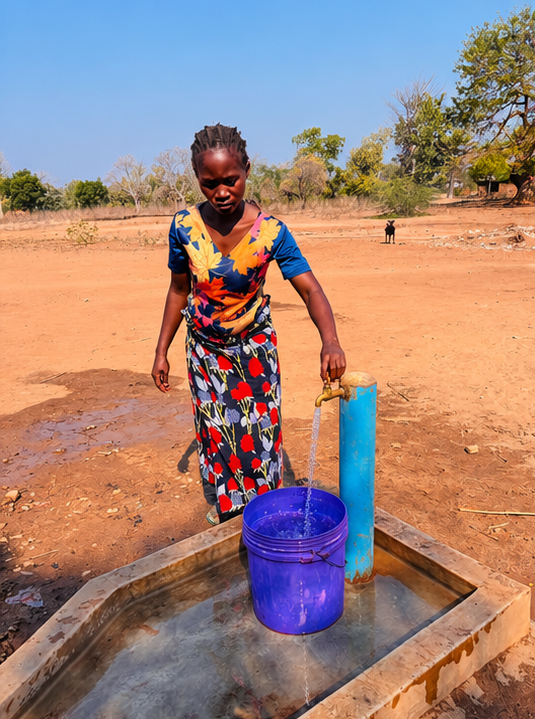


In the community of GVH Nankumba in TA Masache, Chikwawa, Sarah Gama is a familiar face. A mother of four who has lived in the area for nearly 11 years, Sarah's days have always been shaped by the needs of her family and community. Arrive early enough and you'll find her already deep into her day, sweeping the yard, washing dishes, and lining up buckets for what used to be the most demanding task of all: finding water.
"Normally I start the day by cleaning the house, then I go out to fetch water for household use," she says. "After that, I think about what we will eat for lunch, mostly nsima with okra, and sometimes I go out again to find more water for the afternoon and evening."
It's a routine she has followed since moving to Nankumba in 2016, after marriage. Like many women in rural Malawi, her responsibilities stretch well beyond the home. Together with her husband, she secures food through farming and piecework, and she volunteers at a Community-Based Childcare Centre (CBCC), where she serves as a class leader.
But for a long time, everything revolved around water, or rather, the lack of it.
Before the solar-powered reticulated water supply system was built in Nankumba, water was a daily struggle. The nearest boreholes were about two kilometres away, and even then they didn't always give clean or reliable water.
"Finding water was very difficult," Sarah recalls. "Sometimes we would go all that distance and still find long queues. Other times, we had to use water from the river." The trips weren't only exhausting. They ate into time meant for farming, childcare, or rest. Most days she could manage only two or three trips, rationing what she carried home.
"The water was not of good quality," she explains. "We had cases of diarrhoea in the household because of it. And we spent so much time just trying to find water."
She pauses, then shares a moment that still stays with her.
"There was a time I wanted to go to church," she says. "But when I went to fetch water, I found a long queue. I came back late, and we couldn't go anymore. The whole family stayed at home. I was very disappointed." A small story, but it captures how unreliable water quietly shapes daily life, narrowing time and choices.
So when word spread that a piped system might be built in Nankumba, it felt almost unreal. "We used to hear that other communities had water coming out of taps," Sarah says, smiling. "I would wonder if that kind of privilege would ever reach us."
That possibility became real through a solar-powered reticulated water supply system implemented by BASEflow under Trocaire, with additional funding from Electric Aid. The system serves several communities through five tap stands across five locations, including one at Ndalapa Primary School. There, a former borehole has been upgraded into part of the wider system, giving pupils and teachers faster access to clean water. Solar panels power the system, and a 5,000-litre storage tank keeps supply steady through the day.
When the water finally reached Nankumba, the effect was immediate.
"The first time we used the tap, it was an amazing feeling," Sarah recalls. "The water tasted fresh, very different. The women in the community ululated in joy. It was a moment of relief, of pride, of achievement." The difference was visible too. "My children used to look chalky, sometimes itchy after bathing," she explains. "But now, even before applying oil, they glow."
Her days look different now. "I can now plan my day better," she says. "I don't have to spend so much time looking for water anymore." The hours once lost to walking and queuing have come back. She spends more of them in the fields, supporting her family, and thinking ahead. "I'm planning to start a business," she says. "Now I know I have the time. Life is easier. I feel less burdened, and more empowered."
The change shows in her children, too. Mornings are no longer a scramble to find bathing water before school. "They can get ready in good time and go to school," she says. "Before, I would sometimes have to ask neighbours for water. Now, that worry is gone."
The benefits reach well beyond one household. "The women are really benefiting," Sarah explains. "Water is now close by, and it's easier to collect than using a borehole pump." Women are also central to running the system. Many sit on the committee that maintains the water points and encourages good sanitation. "They remind people to sweep and mop around the tap," she says. "They help take care of the system."
A handover built to last
Keeping the water flowing, though, depends on what happens after construction, and this is where Nankumba departs from the usual approach.
In much of rural Malawi, a new water system is handed over after three to five days of training, and then the implementer leaves. When a pump breaks or a committee loses momentum, there is often no one to turn to, and many systems fall into disrepair within a few years for exactly that reason.
Nankumba is being managed differently. Instead of a short-lived committee, the community has set up a service provider, a community social enterprise that runs the system as a small local business: collecting tariffs, handling maintenance, and keeping supply reliable. Training still happens, but here it is the start rather than the finish.
The handover follows a Build-Operate-Transfer approach, staged over a full year. For the first six months, BASEflow co-leads day-to-day management alongside the service provider, working through real problems together as they come up. Between months seven and nine, BASEflow steps back and the service provider gradually takes the lead, with mentorship on hand where it's needed. From month ten to twelve, BASEflow moves to hands-off remote support, monitoring from a distance while the service provider runs things on its own.
By the end of the year the community has not just sat through training. It has run the system and worked through real breakdowns, with support that tapers off only as local capacity grows. It is a slower handover by design, and one built to hold long after the project ends.
Sarah is clear about what this asks of the community. "I am very ready to contribute in every way possible, including paying tariffs to keep the system working," she says firmly. "If we don't take care of it, we will go back to the old ways." Access alone isn't enough. Keeping the water flowing depends on ownership and steady upkeep.
And for those who made it possible, her message is simple. "This kind of development is very welcome. It's not something we can achieve on our own. We are very grateful, and we hope it can reach other communities in need."
In Nankumba, water no longer dictates the rhythm of daily life. It enables it. For Sarah Gama, and many like her, the system is more than infrastructure. It is time given back, and a future that feels, for the first time in a while, within reach.