



Can failed or abandoned boreholes be repurposed?
4 in 5 Malawians depend on groundwater for their daily needs, for drinking, cooking, washing, and watering crops. But the significance of groundwater runs deeper than household use. More than half of Malawi's annual river flows are groundwater-fed, meaning that the health of rivers, wetlands, and ecosystems across the country is directly tied to what lies beneath the surface. Groundwater is, in every meaningful sense, a strategic national asset.
Yet it is an asset under growing threat. Increasing climate variability, erratic and shortened rainfall seasons, and rising demand are placing aquifers under enormous pressure. Water tables are dropping, dry seasons are stretching longer, and communities that once relied on a borehole as a lifeline are increasingly finding that lifeline failing them.
The Hand Pump Problem Nobody Talks About
Across rural Malawi, the hand pump is the primary interface between communities and the groundwater beneath them. Millions of people walk to a hand pump every day. It is the first thing children pass on the way to school. It is where women gather before dawn. But a quiet crisis is unfolding at these pumps. Thousands have stopped working, and many will never work again.
The conventional assumption has long been that hand pump failure is a maintenance problem i.e. broken handles, worn washers, water committees that stopped collecting fees. Maintenance does matter, but our research tells a more uncomfortable story. Over 72% of hand pump failures in Malawi are not caused by poor maintenance at all. They fail because of poor construction, poor installation, poor siting, or because the aquifer they were drilled into simply cannot sustain a yield. The water was never reliably there to begin with, or it has since disappeared entirely.
These are not pumps that can be fixed with a spare part and a volunteer. These are permanently failed assets, boreholes that communities invested in, governments funded, and donors supported, now standing rusting away across the Malawian outback. Stranded infrastructure. Sunk costs. And in a country where groundwater is this critical, a missed opportunity.
What If Failure Could Be Repurposed?
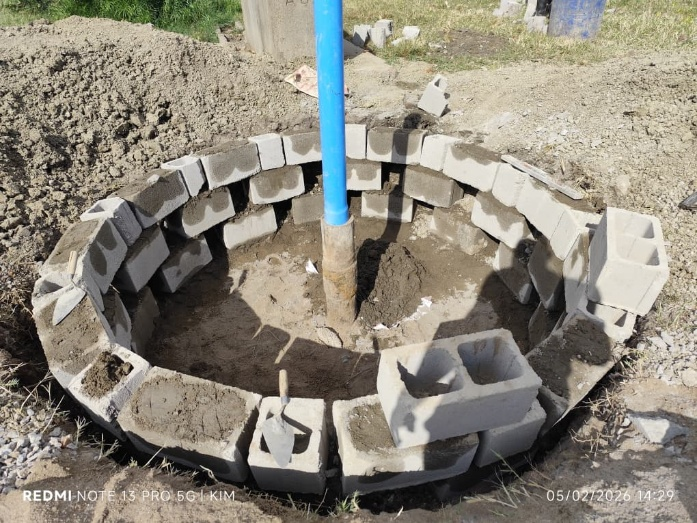
Rather than capping and walking away from a failed borehole, we are working on an approach that converts these stranded assets into recharge wells, infrastructure that captures rainfall and surface runoff and directs it back underground, intentionally replenishing the very aquifers that communities depend on.
This is Managed Aquifer Recharge, or MAR, applied through failed boreholes. This means that we are, effectively, extending the useful life of a piece of infrastructure that was presumed dead.
The mechanics are fairly straightforward. Where conditions are suitable, with soil type, topography, and local hydrology all playing a role, a failed borehole can be retrofitted as a recharge point. Runoff is captured from rainfall using trenches or diversion channels, filtered to remove sediment, and directed down into the borehole, from where it percolates into the aquifer below. Water that would otherwise race across the surface and be lost is instead stored underground, where it can stabilise or replenish the water table, benefiting not just one point but the broader network of functioning boreholes and wells in the surrounding area.
Proof of Concept: Balaka District
In Balaka District, we have established our first MAR site using this approach, integrating rainwater harvesting with groundwater recharge through a repurposed borehole. This is early days, and deliberately so.
The site has recently been commissioned, and we are now running a structured monitoring programme to assess its performance before drawing any firm conclusions or thinking about scale. Over the next year or so, monitoring will focus on the recharge well itself, tracking how effectively it captures and directs water into the aquifer, and identifying any adjustments needed along the way. Over a longer horizon of 2-3 years, the focus will shift to nearby drinking water boreholes, to see whether groundwater levels in the surrounding area show measurable improvement as a result of the recharge.
This phased, evidence-led approach reflects a deliberate commitment to getting the model right rather than moving fast. The ambition is real, but the discipline is to let the data lead.
It also matters enormously from a cost and scale perspective. Drilling a new borehole is expensive, disruptive, and not always successful. Repurposing an existing one, one that already has a casing in the ground, already has a known location, and already sits within a community's landscape, is a fundamentally more efficient use of resources, essentially turning a liability into an asset.
If this works the way we hope it will, the potential benefits will extend beyond individual wells. As aquifer storage increases, dry-season water availability improves. Functioning boreholes nearby become more reliable. Communities grow more resilient to droughts and climate variability. Irrigation and livelihoods are supported through more consistent access to water.
The Challenges Are Real
MAR is not a universal solution, and we are clear-eyed about that. Not every abandoned borehole is a candidate for recharge. Site-specific assessments of soil, geology, and topography are essential before any intervention takes place. Community awareness and engagement are equally important: the benefits of recharge are not immediately visible. Unlike a new pump that delivers water the same day, recharge works slowly and out of sight, and communities need to understand and trust the process for it to be sustained over time.
Monitoring and maintenance require ongoing commitment. But these are challenges of implementation, not of concept, and they are ones we are working through on the ground.
A Different Way of Thinking About Water
Malawi has thousands of failed boreholes across its landscape representing millions of dollars of wasted investment that did not deliver. And for decades, the default response has been to drill another borehole and ignore that the failed one even exists. This work excites us because it represents a shift in how we approach failed water infrastructure, from writing off failure to finding a purpose for it. We do not yet know how far this approach can scale, or how many of Malawi's failed boreholes are suitable candidates for recharge. That is what the monitoring in Balaka will begin to tell us. But the question itself feels like progress. For too long, a failed borehole was the end of the story. We think it might just be the beginning of a different one.