

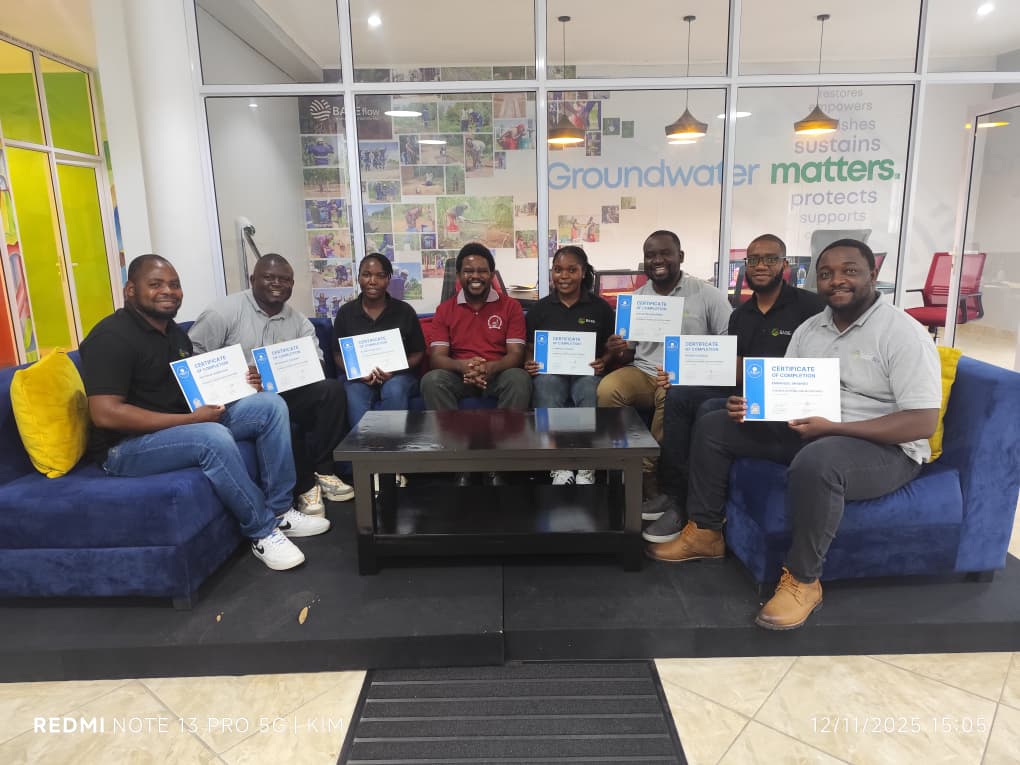
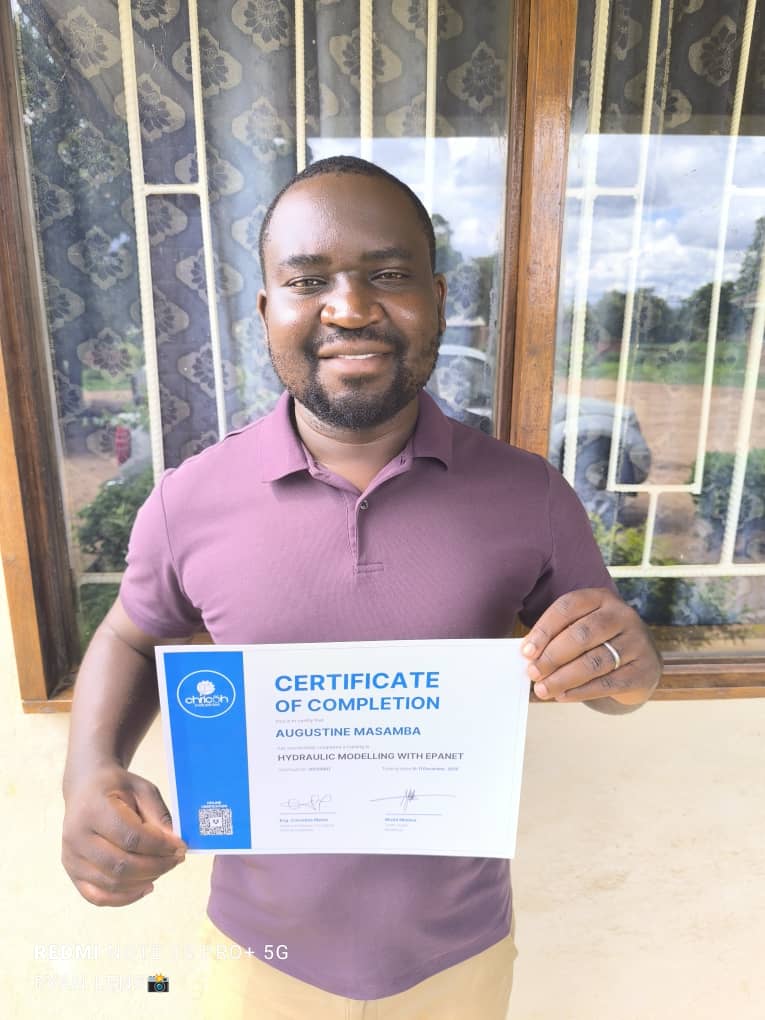
For many who work in water, understanding a system often begins in the field; standing beside a rising main, tracing a pipeline through a hillside, or listening to community frustrations when yield drops without warning. But for Augustine Masamba, a Programmes Officer at BASEflow, the last week proved that understanding a water system can also begin in front of a computer screen.
From 8–11 December, BASEflow hosted a four-day intensive training on EPANET, a water-network modelling software that simulates hydraulic behaviour in piped distribution systems. The training was facilitated by Cornelius Mpesi, technical delivery consultant from ChriCoh Industries, an innovation-led engineering outfit that provides context-driven solutions across water, mechanical, and electrical systems.
The training was born out of a growing need.
BASEflow’s work with reticulated water-supply systems has expanded, and with it, the demand for deeper technical understanding; from system design to energy efficiency, to troubleshooting failures in the field. EPANET, with its powerful ability to simulate flow, pressure, demand, energy use, and storage dynamics, was the perfect place to begin strengthening that capacity.
But there was another motivation behind the training, one deeply rooted in BASEflow’s philosophy. While certain EPANET-related skills have historically resided with a few technically skilled individuals, BASEflow believes strongly in diffusing knowledge across the organization so no single person becomes the “holder” of critical expertise. The logic is simple. For an organisation committed to strengthening Malawi’s water resilience, knowledge must be shared, not siloed. The training was therefore designed not just to build capacity, but to democratize it. Technical staff across departments needed to feel confident that they too, like their engineering counterparts, could model systems, analyse designs, and contribute meaningfully to engineering decisions.
As the training started that grey Monday morning, it was clear that this was not going to be a week of PowerPoint slides and long lectures. Cornelius insisted that everything taught had to be immediately applied. Every concept was demonstrated through a hands-on exercise: pressure zones, pump curves, junction demands, pipe roughness coefficients, velocity limits, and flow balancing.
“It felt like the system was talking to us,” Augustine shared. “Sometimes you see a pipeline on the ground but you couldn’t fully understand what was happening inside it. EPANET lets you see that invisible world.”
For him, the moment everything truly clicked was during the session on solarization of water supply systems, which served as the final wrap-up. The team learned how solar pumping interacts with hydraulic behaviour, and how the right accessories such as controllers, safety devices, and energy-matching tools protect systems from damage and inefficiency.
“It connected everything,” Augustine said. “Now we could see how design, solar energy, pressure behaviour, and community use all fit together.” Reflecting on how the training will shape his upcoming work, Augustine added another practical example.
“In Balaka, for one of the projects we are starting, we’ve proposed two water supply systems,” he explained. “With what I’ve learned this week, those are going to be my first real hands-on designs. And I want to work closely with our innovation and design specialists so that work which would have been outsourced before can now be done right here within BASEflow.”
One of Augustine’s most striking reflections was how the training took complex engineering ideas and made them feel accessible. “In the field we see the challenges; low pressure, pipe bursts, tanks that don’t fill, taps that run dry,” he explained. “But EPANET shows you the science behind the symptoms. You stop guessing. You understand.”
The team built sample reticulation networks, changed elevations, applied different pump parameters, tested pressure losses, and observed how altering just one variable shifted the entire system.
But most importantly, Cornelius encouraged mistakes.
He wanted participants to break the model, fix it, break it again, and learn why each error mattered. “It gave me confidence,” Augustine said. “Now when I go to the field, I won’t just collect data, I will understand how that data shapes the whole system.”
BASEflow’s involvement in complex water-supply systems has grown significantly, from diagnosing failures, to supervising construction, to supporting community management of reticulation networks. Yet meaningful participation in these processes requires the ability to: analyse designs rather than simply receive them; identify the root causes of hydraulic issues; communicate clearly with engineers and contractors; support communities with informed technical guidance; troubleshoot breakdowns using evidence, not assumptions.
The EPANET training was therefore not just a capacity-building exercise, it was a strategic shift. “We needed this,” Augustine emphasized. He also noted that this shift is bigger than individual skills, it strengthens BASEflow’s standing in the sector.
“Now we can produce realistic BOQs, proper designs, and defend our technical decisions,” Augustine said. “It means when BASEflow supports partners, we’re speaking from evidence, not guesswork. People will trust that we know what we’re doing. It puts us out there as a serious technical player.”
On the final day, as certificates were awarded and Cornelius packed away his equipment, there was a clear sense that something important had happened, something beyond learning a new software. There was confidence. There was curiosity. There was excitement to apply new knowledge.
But Augustine said it best: “We don’t just want to be present at the design stage, we want to contribute. We want to help improve water systems, prevent failures, and make sure communities get the service they deserve. EPANET gives us that power.”
Trainings such as these are part of BASEflow’s new strategy of enhancing skills and capacity to effectively deliver the ambition of our vision where we want to create “a world where no well runs dry”. Because in the world of water: Understanding is empowerment. Insight is prevention. And knowledge, like groundwater, must keep flowing to everyone who needs it.